
Built for the competitive listing appointment
Listing Presentation for Realtors — Print Leave-Behind + Slide Deck
Open with the seller. Work through pricing. Leave with the plan in writing.
A seller-first listing presentation for agents who want the appointment to move from the seller’s goals, through market evidence and pricing choices, to a written launch position.
It comes as a 16:9 presentation deck and a separately composed 8.5 × 11 working leave-behind. Both are editable in Canva, and both work with Canva Free.
$39 · Includes both formats
18-page print + 19-slide deck · Canva Free · Instant download
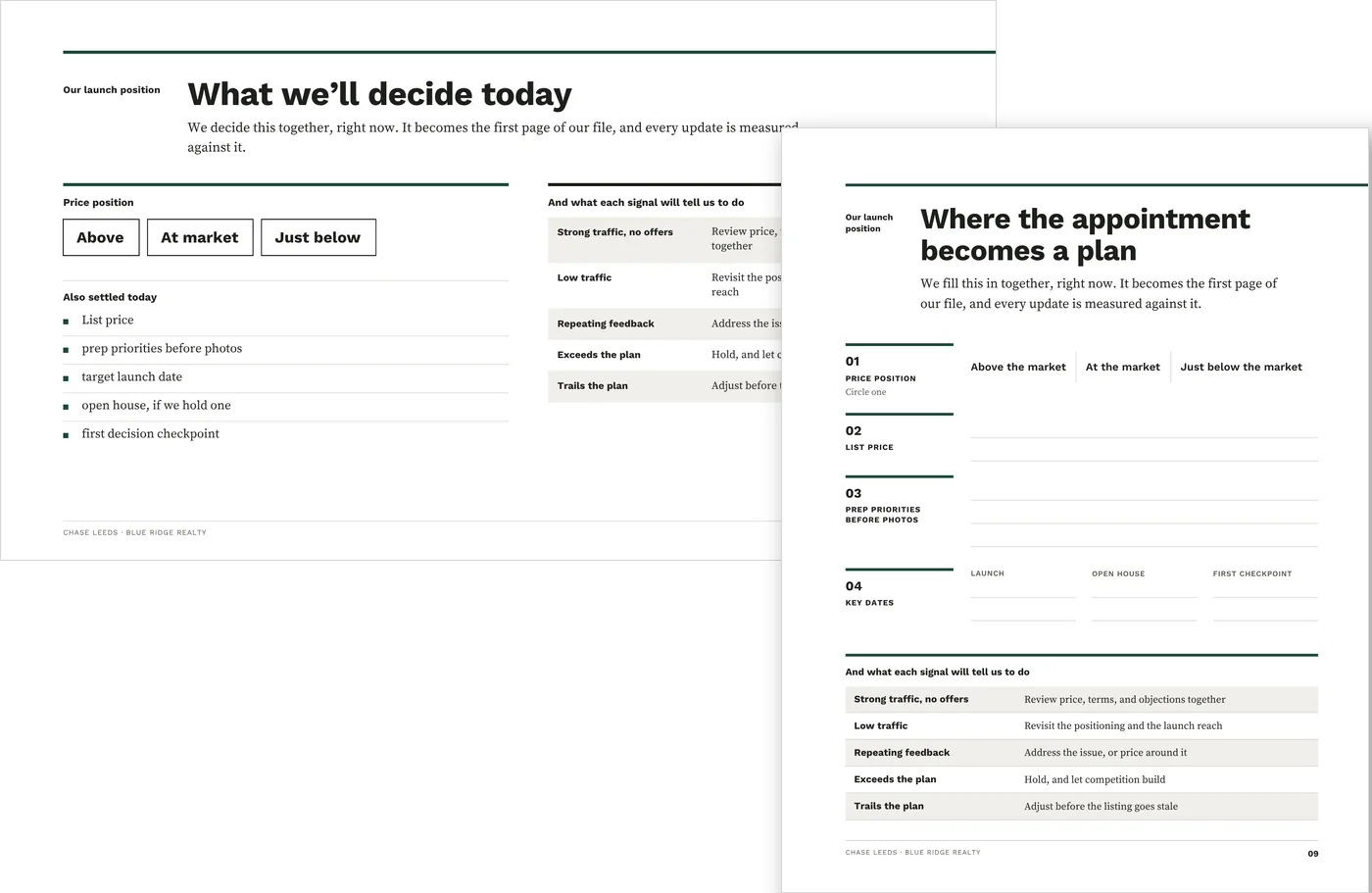
Talk it through on screen. Record the decision on the printed page.
Pricing becomes a decision you work through together
The presentation does not jump from the comps to the number you recommend. It moves from evidence to choices, sets out what each choice costs, and finishes with the launch position written down.
Three ways to position
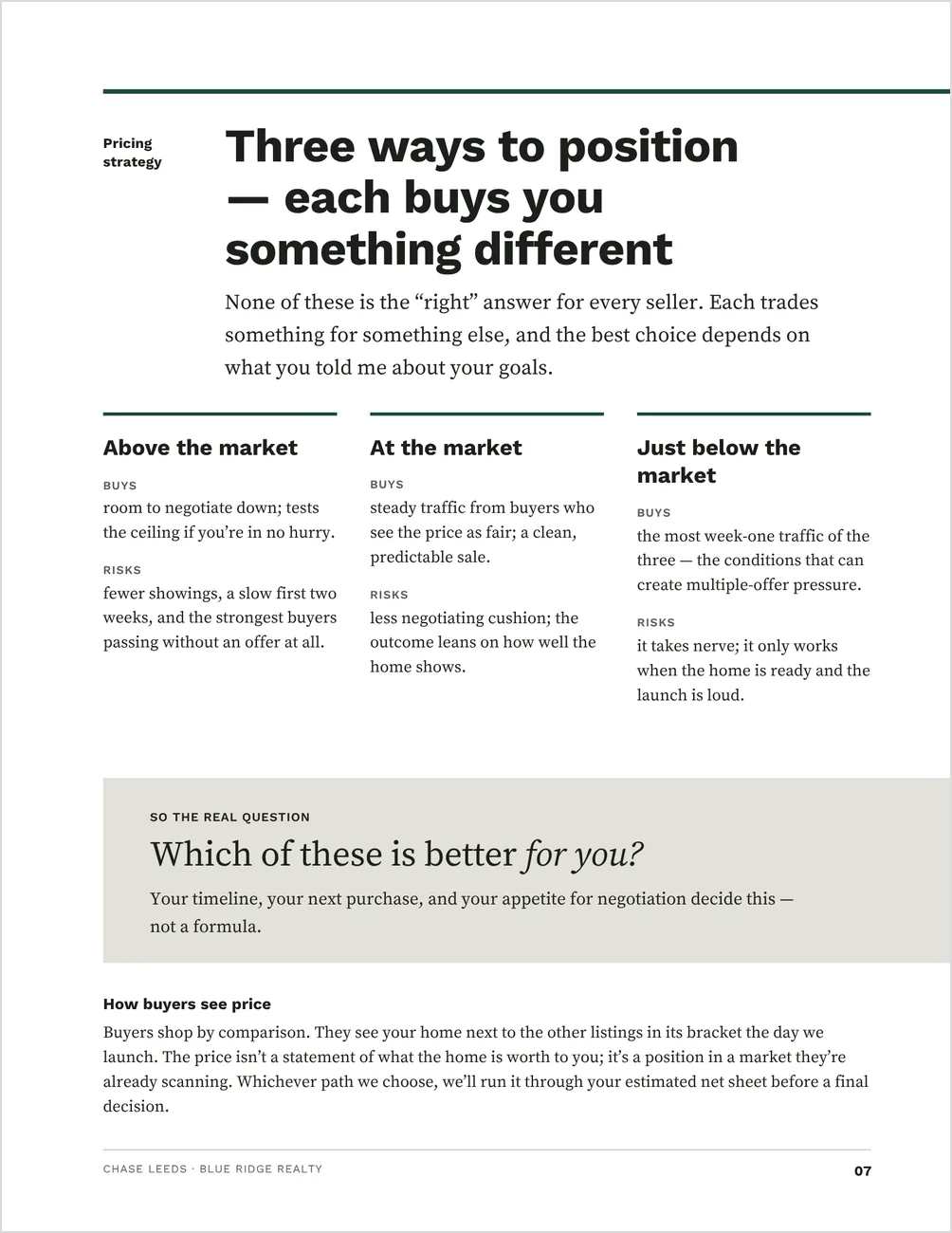
Page seven. The seller sees all three before you recommend one.
Why starting high can cost you
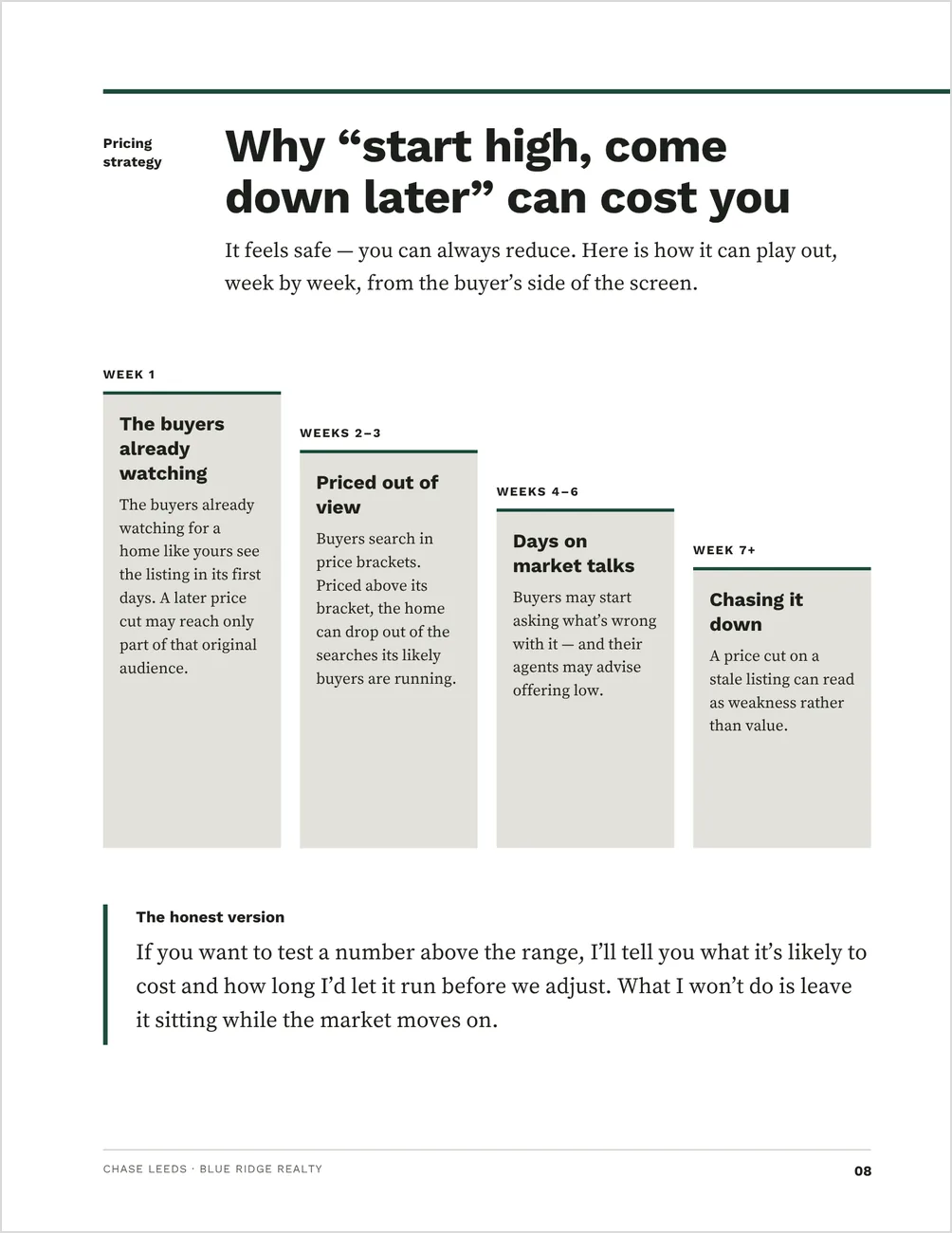
Page eight. Week one to week seven and beyond, in four stepped panels, with a closing note on what you will and will not do about it.
Where the appointment becomes a plan
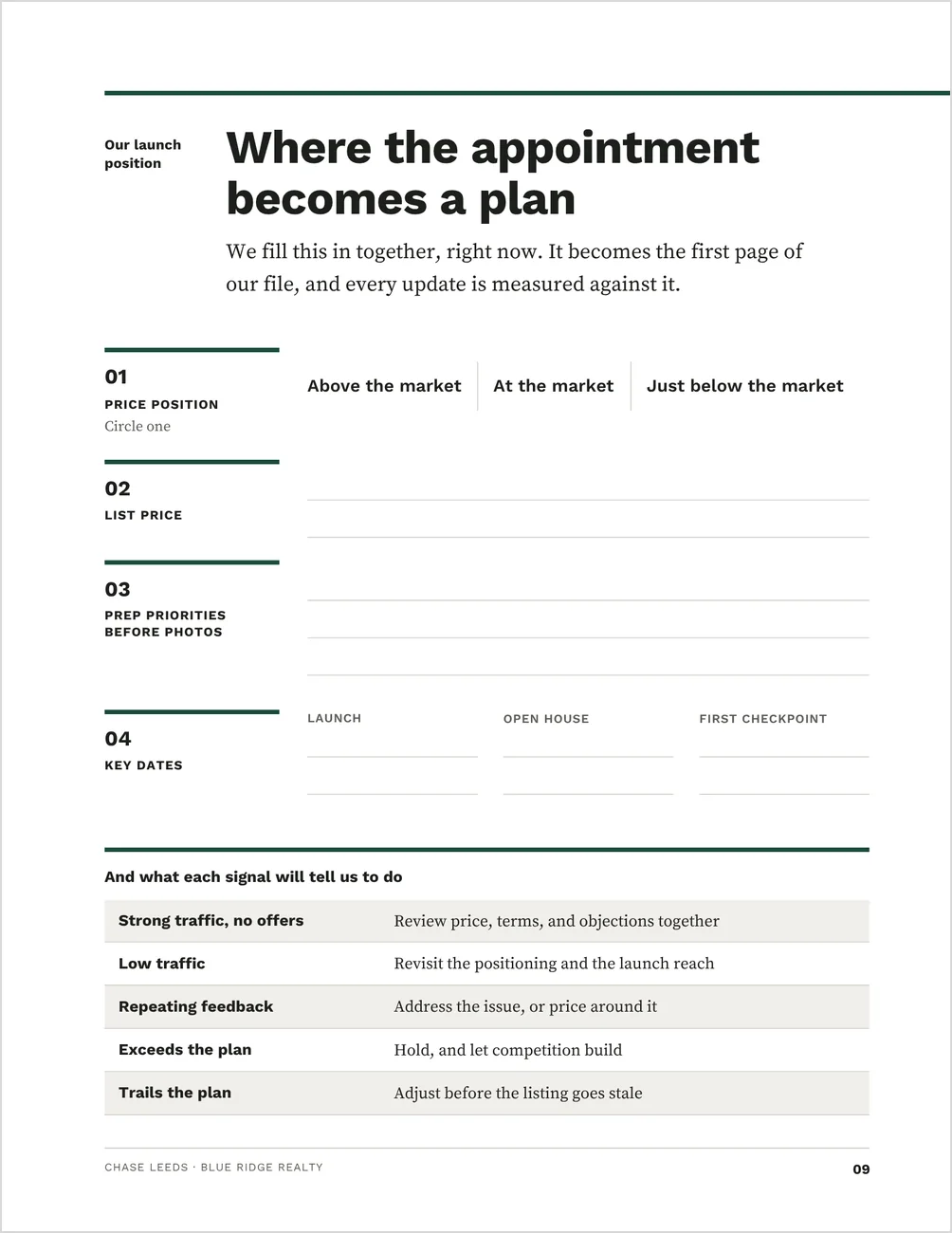
The pricing conversation ends in writing, filled in together while you are both still at the table. Page nine records:
- the price position, circled from the three you have just worked through
- the list price
- prep priorities before photos
- key dates: launch, open house, first checkpoint
- what each market signal means you will do, from strong traffic with no offers through to a listing that trails the plan
The seller agrees in writing what different market signals mean, so later decisions follow the plan instead of reopening the pricing conversation from scratch.
Use the full presentation, or copy the pricing sequence into the Canva presentation you already use.
Page nine ships blank, to fill in with the seller.
Best for listing agents who would rather present evidence than credentials
You want the pricing conversation to happen on evidence, in front of the seller, and you want to leave behind something that says the same thing.
A good fit if you:
- present on a laptop or tablet at the appointment and still want a printed copy on the table
- meet sellers who already have a number in mind and have not been shown where it came from
- pull your own comps and want a page built to present them
- are building a proof path without a long sales history — the track-record page has an alternate for that
Not ideal if:
- you want the analysis done for you — it is a template, not a market analysis, and it does not include a completed CMA
- you need brokerage-specific agency or disclosure language — that comes from your own forms
Present on screen. Work from the print version. Leave it behind.
The 16:9 deck.
Built for presenting the conversation live on a laptop, a monitor or a television. The launch position arrives as a summary the room can read at a glance.
The 8.5 × 11 leave-behind.
Built for working through the decision at the table and leaving the written plan with the seller. The same page carries ruled fields to fill in by hand.
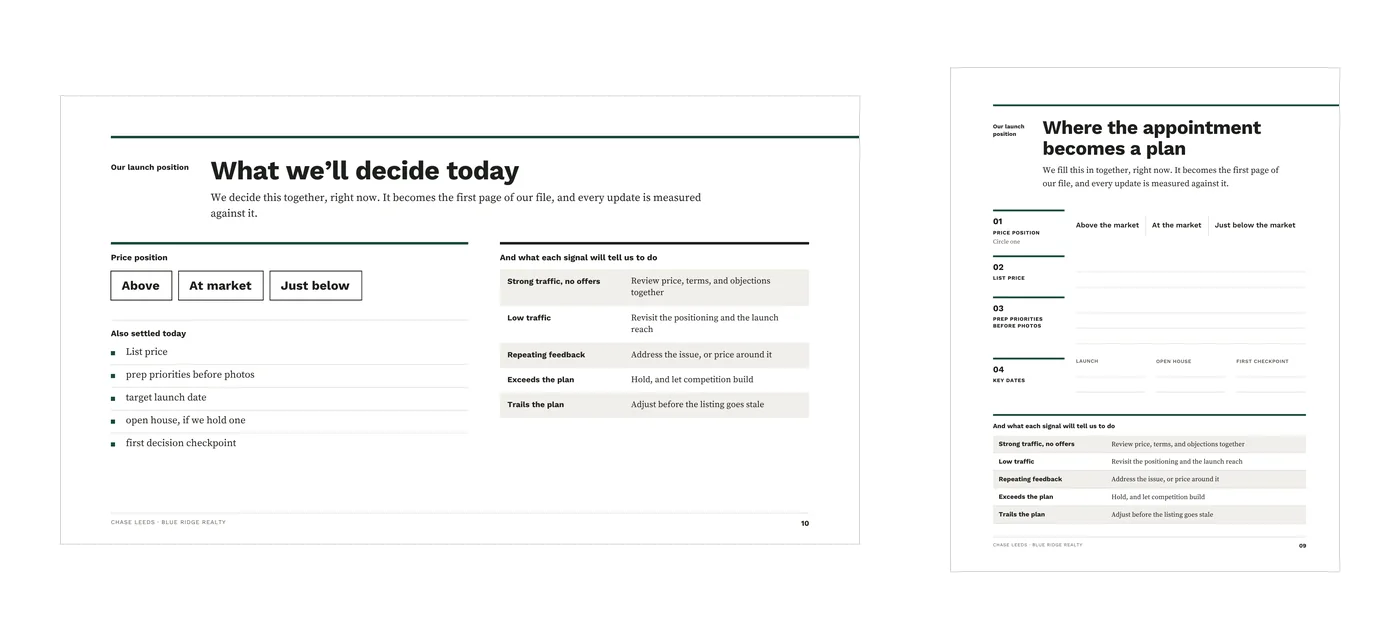
Slide ten of the deck and page nine of the leave-behind. Same decision, composed separately for each job — different headline, different layout, and write-on rules only on the printed page.
The 16:9 and 8.5 × 11 versions are separate Canva templates, so property-specific information that appears in both — the address, the comps, the value range, the price positions — is updated in both. Nothing transfers between them automatically.
Proof and fee still matter. They just come after the decision work.
Marketing, process, track record and fee are all in the file, on the pages after the pricing sequence.
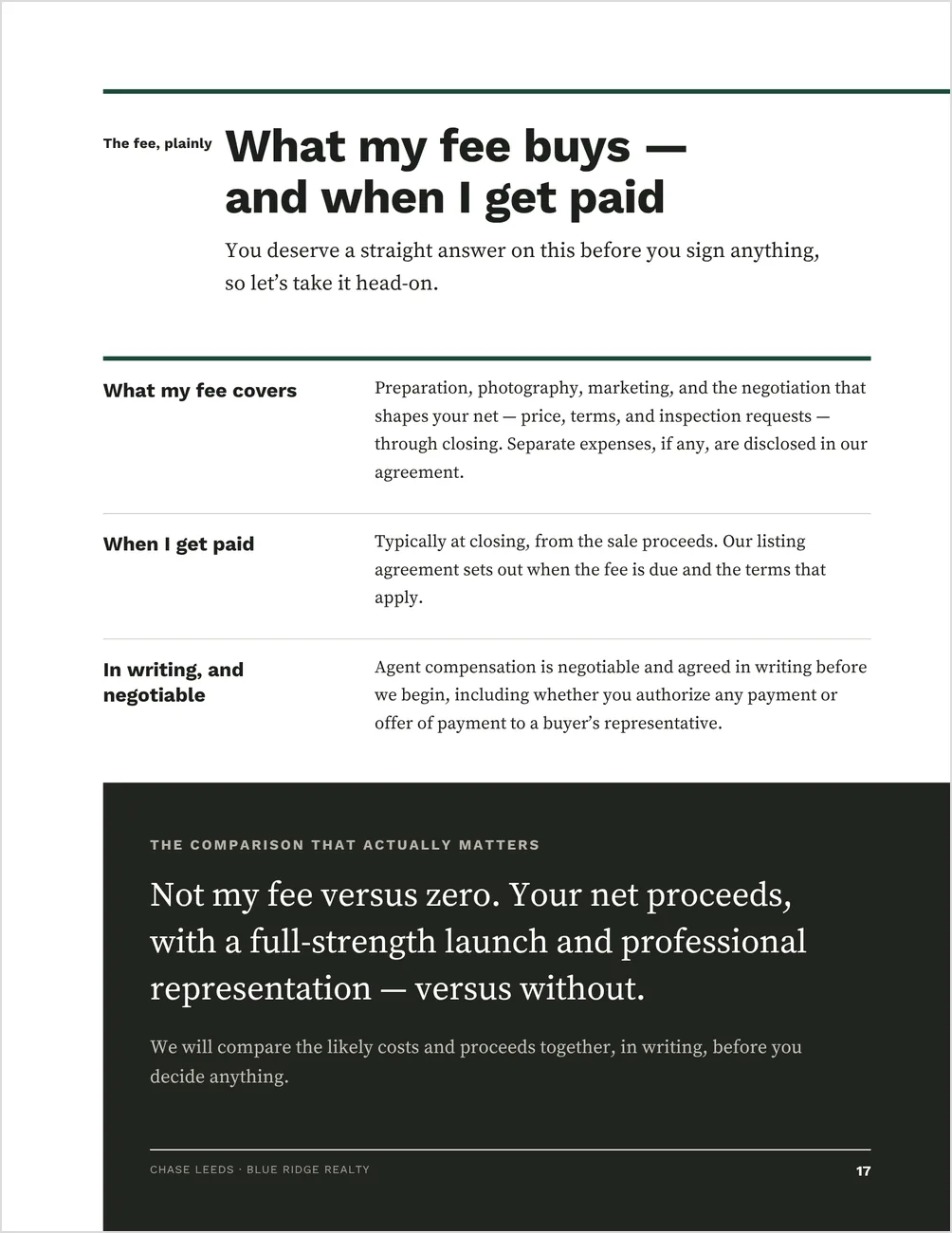
Page seventeen. Compensation is stated as negotiable and agreed in writing.
Three alternate pages, fully designed
Each alternate sits at the back and carries the number of the page it takes over, so a swap needs no renumbering and the presentation is the same length either way. Which pair you use depends on what you want to put in front of this seller, not on what you have.
The cover.
The default runs the photograph included with the template. The alternate is type-led, for a cover with no image.
The marketing page.
The default holds frames for pieces from your own recent listings. The alternate shows how the plan runs from prep to close, phase by phase, and needs no images.
The track-record page.
The default leads with your results. The alternate leads with four commitments a seller can check before they list and measure you against afterward.
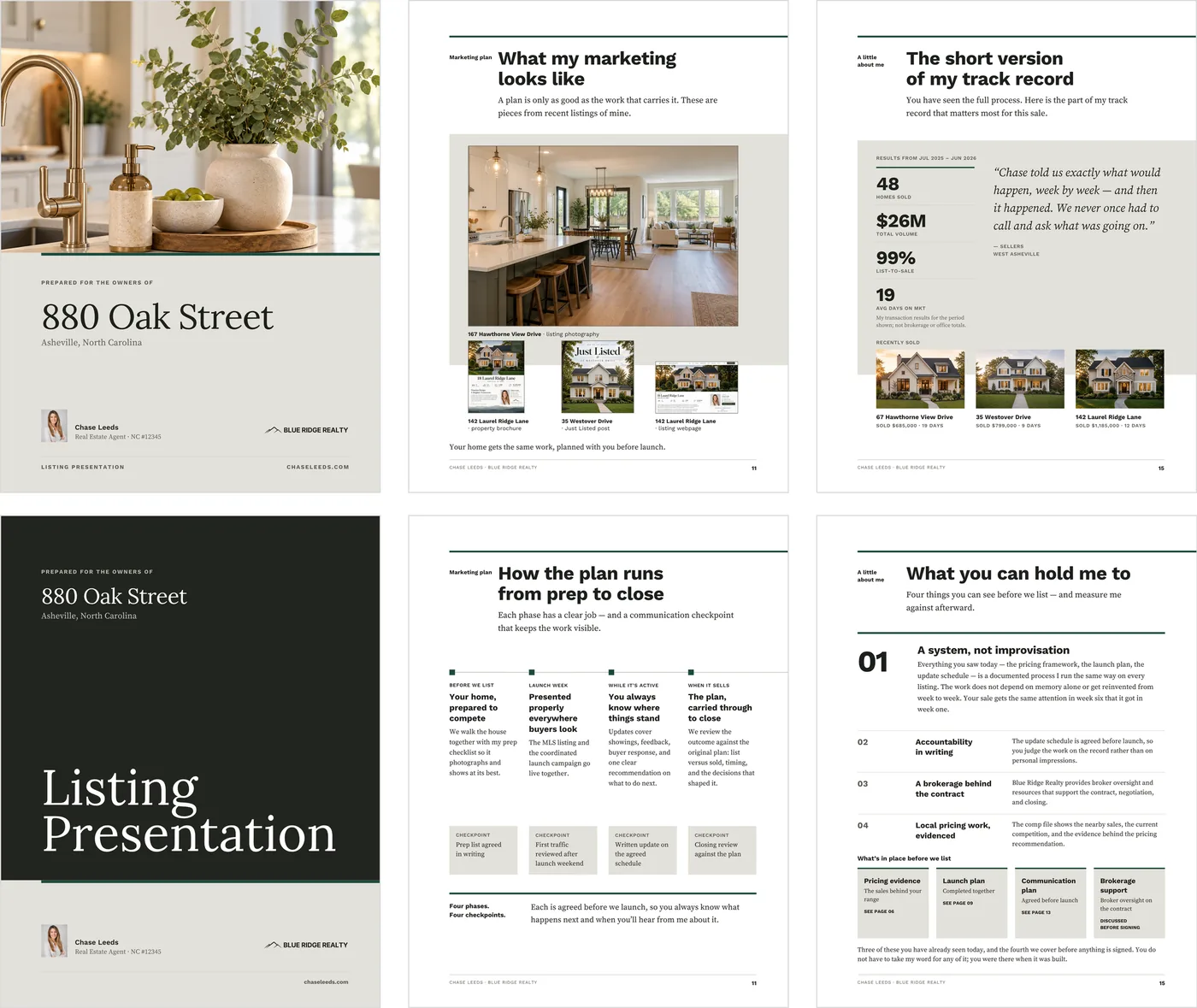
Defaults on top, alternates below. The marketing frames are shown filled as an example; they ship empty.
The full presentation, all 18 pages
You have seen what makes the sequence different. This is the rest of it: 18 pages presented in the leave-behind and 21 in the file, with the deck carrying the same pages as 19 slides and 22 in the file. The extra pages are the alternates, not extra presentation.
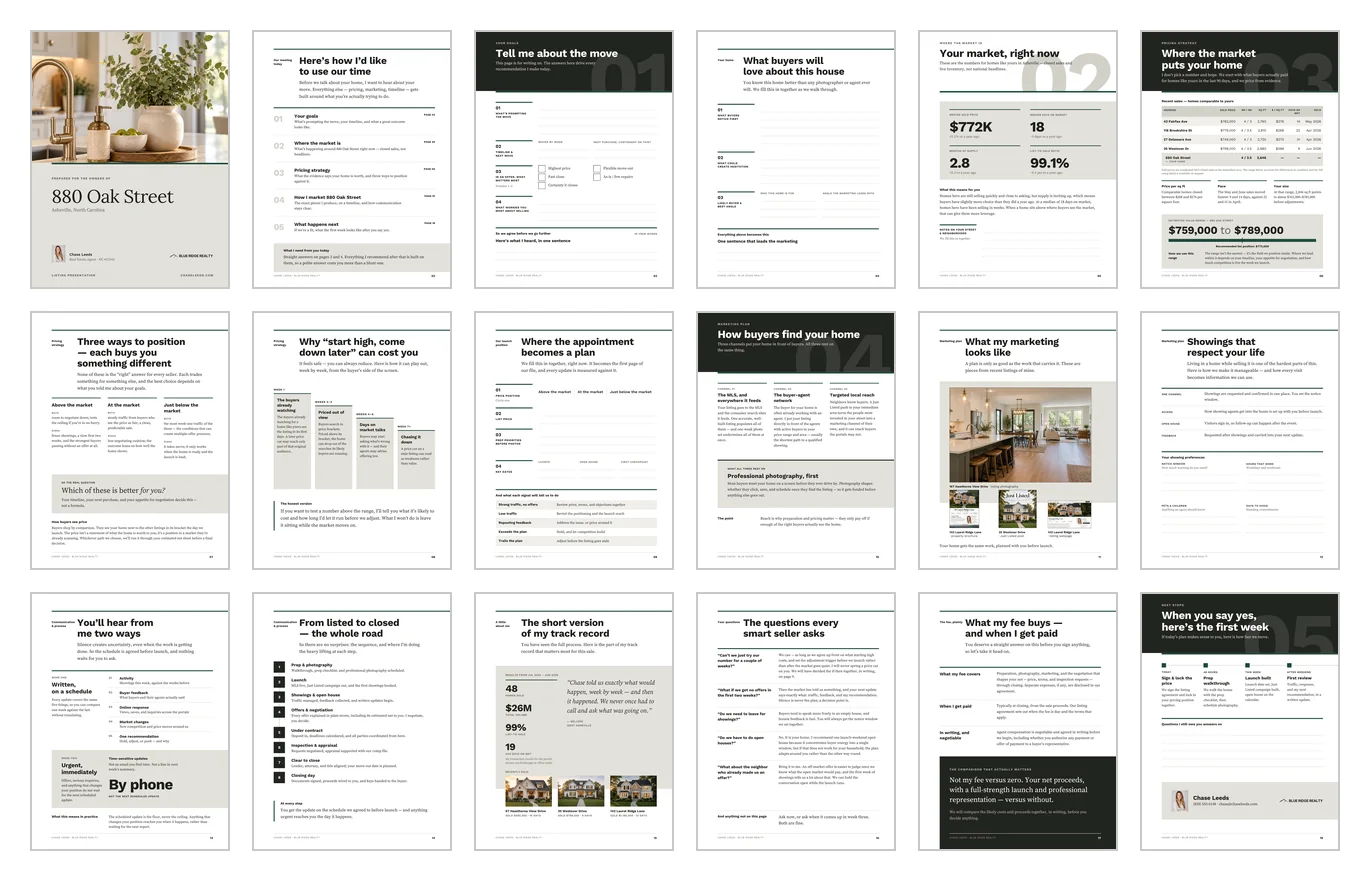
Shown as the worked example it ships with. The marketing frames on page 11 ship empty, for pieces from your own recent listings.
Their move and their home
- Cover and agenda
- Tell me about the move (write-on)
- What buyers will love about this house
- Your market, right now
- Where the market puts your home: the comps and a value range
Pricing and the plan
- Three ways to position
- Why starting high can cost you
- Our launch position, filled in together
- How buyers find your home
- What my marketing looks like
- Showings that respect your life
How you work, and what’s next
- You’ll hear from me two ways
- From listed to closed
- The short version of my track record
- The questions every smart seller asks
- The fee, plainly
- When you say yes, the first week
Every conversation page starts with complete default copy, so you are editing rather than drafting. A Quick Start Guide with both template links comes with the download.
Setup is find-and-replace, your comps and one color
1. Add your details.
Find and replace your name and title, brokerage, license number, phone, email and website. Add your headshot, your brokerage logo and the property address on the cover.
2. Set the brand color.
Both files ship with a bright magenta accent. Select one accent, use Change all, and the whole file moves to your color in one pass. Any magenta left behind marks a missed accent.
3. Enter the market and the comps.
Add the market figures and three to six comparable sales for this property, with the seller’s home in the last row. Then set the value range and the three price positions.
4. Choose your pages.
Pick your cover, marketing page and track-record page, and delete the ones you are not using.
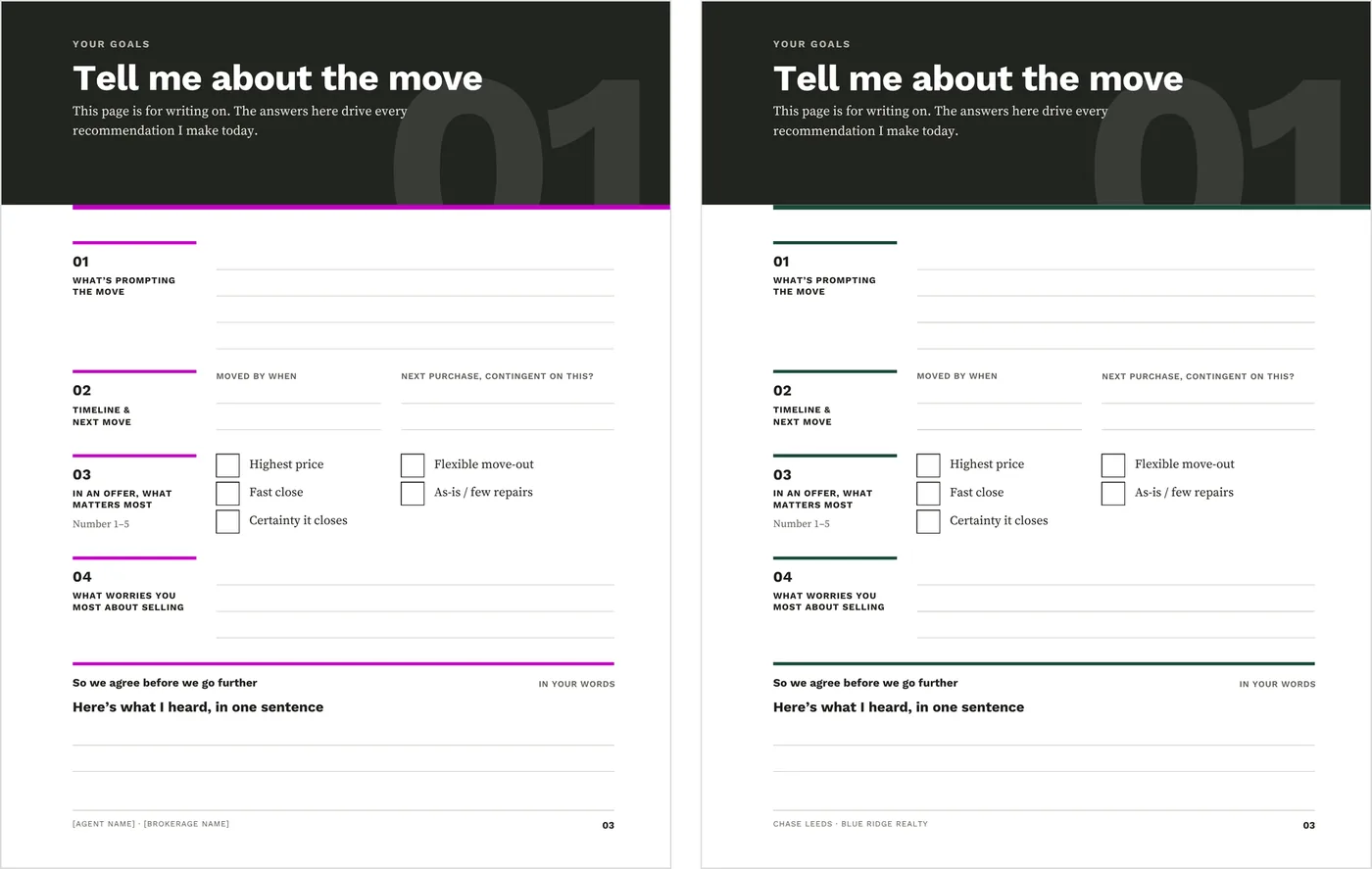
As it downloads, and after the brand color is set.
Your identity, branding and page choices are set once. For each appointment you update the address, the market data, the comps, the value range and the list position in both files, then download and print the leave-behind.
Canva Free, two sizes, and what it doesn’t do
Everything edits on Canva’s free plan, including the one-pass color change. Headshots read best at 600px or more on the short side, the cover photo at 2500px wide, and listing photos at 1200px wide.
A few pages have working limits, noted in Canva where you need them: three to six comparable sales, a testimonial of two to three sentences, and a property address of about thirty characters.
It is a static template: it does not connect to MLS data, a CRM or live data, and it does not include a completed CMA. It is a digital download, and nothing physical ships.
What to know before you buy
Two separate files.
The screen deck and the print leave-behind are separate Canva templates. Property-specific information has to be updated in both wherever it appears.
You supply the analysis.
The template does not create the CMA, select the comparable sales, set the value range or recommend a list price. The comps, range and pricing figures ship as a worked example to replace. They are illustrative only, and not a valuation of any home.
Marketing examples.
The default marketing page holds frames for pieces from your own recent listings. If you would rather not supply them, the phase-plan alternate needs no imagery.
Local review.
Fee, disclosure, agency and compensation language should be read against your own forms, your broker’s policy and your state’s requirements. The fee page states that compensation is negotiable and agreed in writing.
Before you present it to a seller
- Replace every figure with your own verified local data
- Fill the marketing frames only with pieces from your own listings, or use the phase-plan alternate
- Read the first-person commitments on communication, marketing and showings as your own words, and edit anything you would not personally promise
- Review the fee page and the process pages against your own forms and your broker’s policy
- Replace the sample agent name, brokerage, license number and contact details
Once the listing goes live
Keep the seller informed with the Seller Reporting System. Track the market response, your marketing activity, feedback and next steps against the launch position you agreed at the appointment.
Before the appointment: the Pre-Listing Packet. On the buyer side: the Buyer Presentation. Each is sold separately, and this presentation needs none of them.
Common questions
Do I get both the deck and the printed version?
Yes. You get two Canva template links, built from one master and carrying the same content in the same order.
Does it include a CMA?
No. The comps page is built for your own comparable sales. The figures it ships with are a worked example to replace.
I don’t have a long sales history. Does it still work?
Yes. Move in the track-record alternate, which leads with four commitments a seller can check before they list, and delete the default.
Do I need Canva Pro?
No. Both files edit on Canva’s free plan, and the one-pass color change works there too.
Can I use just the pricing pages in my existing presentation?
Yes. Because the templates are built in Canva Free, you can copy the portrait pricing pages into another 8.5 × 11 Canva design, or copy the matching widescreen slides into another 16:9 presentation. They carry over as editable pages, and Canva’s Copy Style tool restyles them to match what you already use.
Run the appointment in the seller’s order
Open on their move, work through the pricing choices together, and leave with the launch position in writing.